Thursday, January 19, 2006

If the Son Sets You Free...

"Truly, truly I say to you, eveyone who commits sin is the slave of sin..." (John 8:34)
"...for by what a man is overcome, by this he is enslaved." (2 Peter 2:19b)

"So if the Son sets you free, you will be free indeed." (John 8:36)


The seven days I spent in Mexico last week were some of the most joyous (and yet humbling) I have ever experienced. Although much of my time was spent in the technical ministry, a few times I was privileged to serve our great King by personally sharing the gospel with several people. The most memorable of whom was a young man (I forgot his name, so I will refer to Him as Mateo) living in a small, quiet village outside of Caborca.

That evening Lynn Paasch, Victor (a member of the Mexican team), and myself were assigned as a diagnostic team and we were instructed to go out into the village to 1) invite people come see the Jesus film that night and 2) to share the gospel with them directly both through the tapes and tracts as well as conversation. When we arrived at the last house on our route, we saw a small child sticking his face over a wall who was probably wondering why funny-looking gringos were walking up to his house. Victor, Lynn, and I walked over to the other side of the wall and there we found Mateo. After some brief introductions, Lynn asked me to share the gospel with him in English and she would translate.

My mind raced rather quickly as I wondered what would be an appropriate starting point to begin our immensely important discussion. And so I asked him the first logical question:

"Have you ever heard of Jesus?"

He had. After further inquiry, we discovered that he had been to church before but wasn't really into it. Hoping to keep our conversation direct and simple, I asked:

"Do you understand what Jesus did on the cross?"

He slowly shook his head.

I immediately began a brief explanation of sin and forgiveness, emphasizing that sin wouldn't just give him a bad life, but if it was never atoned for, then he will spend eternity in hell. From there, I spoke of God's holiness and why He MUST judge sin. And, of course, this led the way to the Good News that God offered forgiveness and reconciliation to him if he repented and believed that when Jesus died on the cross, his debt was paid in full.

Mateo seemed very open to hearing the gospel message even though there were times that I felt I wasn't communicating very clearly, but Lynn did such an brilliant job of translating and continuing the conversation after I had finished. Shortly afterward, we exchanged goodbyes and handed him a few tracts.

Please, continue to pray for Mateo and countless others who heard gospel during our stay in Mexico. Ask that God would open their eyes to the seriousness of their sin, and their need for the Savior.


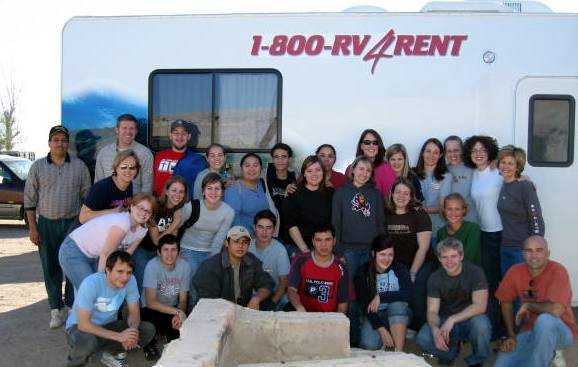
By the way, I was able to snap a quick photo of Mateo at an opportune moment because I saw an immensely strong parallel between his bodily position and his spiritual condition. In the picture, it seems as if Mateo is imprisoned behind bars, anxious and longing for freedom from his helpless estate. In reality, he's just leaning a against a wall. But spiritually speaking, Mateo is enslaved to his sin and in bondage to the devil; he is lost and without hope. He desperately needs Christ to tear off his shackles of sin and give him a new life and new heart. Mateo needs a Savior.

There is a powerful application for those of us who have already repented and believed in Christ:

"But thanks be to God that though you were slaves of sin, you became obedient from the heart to that form of teaching which you were committed, and having been freed from sin, you became slaves of righteousness." (Romans 6:17-18)

Praise be to our great God and Father of our Lord Jesus Christ that we are no longer slaves to sin, but obedient and humble servants working in the service of His Kingdom till death takes us to be with Him forever and ever.


privileged to serve,

Jonathan David Roberts

Monday, January 16, 2006

Gloria a Dios, Hallelujah!


As most of you know, I've spent the last week on a mission's trip in Caborca, Mexico. Twenty-some people from EVBC and about ten girls and guys from a church in Hermosillo came together to witness God do great things and to make His gospel known to the nations. There are loads of stories to share and many memories to recount, but right now I'll just share what I learned and how the trip fared from my perspective.

The first two days were the most humbling for me because that's when I believe that God did the most work in my own heart. I was just SO overwhelmed by His goodness, grace, and mercy. This really hit me one night when we where driving back to Diamante from an evening spent sharing the gospel with a community outside of Caborca. The words of a familiar song kept ringing in my mind:

How deep the Father's love for us,
How vast beyond all measure;
That He should give His only Son,
To make a wretch His treasure.

I just couldn't believe that God, knowing how desperately wicked my heart is, would still choose to step into His own creation and suffer the most searing loss to rescue you me from where my sin would certainly have led me. These words also pressed heavily on my heart:

And when I think that God, His Son not sparing,
Sent Him to die, I scarce can take it in;
That on the cross, my burden gladly bearing,
He bled and died to take away my sin.

God really used a series of events and experiences to chip away at parts of my heart that had grown hard and callous because of my sin. After spending so much time in God's word, seeing God's people serve Him so joyously, and witnessing many come to repentance and faith in Christ, my heart was just overflowing with both sadness and joy. I couldn’t help but ask God, “Why choose me Lord? I’m such a poor reflection.”

One of my favorite moments on the entire trip happened the night that we spent in Campo Rocio (I think. It may have been a different one). I was on the technical team that night, doing most of the behind-the-scenes work and I volunteered to sit on top of the van and take care of the projector. Now, for those of you who haven’t heard stories from the past trips must understand that this is by no means an easy position. Since we used the projector to shoot a movie (either the Passion or a Jesus film for kids) onto the side of the RV, someone has to sit on top of the van during the entire length of the film to make sure it doesn’t fall off or anything. And since any movement will shake the picture, you don’t have much freedom in terms of mobility. This can become quite uncomfortable, especially when the cold start to bite. I thought it was hilarious cause when I jumped off of the van after we were done; my feet were so numb that I didn’t feel ANYTHING when they hit the ground.

Anyway, it was totally worth it, because after the film was over, Pastor Alfonso gave a clear presentation of the gospel and asked for those would wished to receive Christ and learn more of what it means to follow Him, to come forward. I think I counted about 30 or 40 people. It was incredible! But I think the best part was when one of the Christians from the camp came forward and said he wanted to sing a song. That night we heard the doxology (Praise God from whom all blessings flow, praise Him all creatures hear below, etc…) sung in Chol (a local dialect). It was beautiful.

Like I said before, this is just a small sample of God’s unbelievable goodness to us. It would take a considerable amount of time to recount all that God did this past week. But for even the smallest of amount of grace, I am eternally thankful.
Mi Corazon, entona la cancion,
Cuan grande es El, Cuan grande es El.

Tuesday, January 03, 2006

Acapella

This weekend I celebrated New Year's Eve at Eli and Heather's joint. It was fantastic; we played games, ate loads of good food, and I got the chance to play with Micah!!! Good stuff...

Anyway the most memorable part of the night (for me anyway) was when we (Casey, Kayce, Jerry, and Tim) were all gathered around in the kitchen and somehow we randomly started singing hymns. To this moment I'm not sure how it all began, but it was so amazing. As soon as we were finished singing one, someone would immediately pick another hymn, and we'd all jump in (although some of us knew more of the words than others ;) ). Even though we were slightly off key half the time and managed to butcher a couple beautiful melodies, I was deeply moved.

I was reminded how much I love the hymns; they have so much to say about our faith. Two hymns in particular that we sang remain poignant in my mind: Be Thou My Vision and How Deep the Father's Love For Us.

I encourage you to read over them and let the words sink in...


How deep the Father's love for us
How vast beyond all measure
That He would give His only Son
To make a wretch His treasure

How great the pain of searing loss
The Father turns His face away
As wounds which mar the chosen One
Bring many sons to glory

Behold the Man upon a cross
My guilt upon His shoulders
Ashamed, I hear my mocking voice
Call out among the scoffers

It was my sin that held Him there
Until it was accomplished
His dying breath has brought me life
I know that it is finished

I will not boast in anything
No gifts, no powr's, no wisdom
But I will boast in Jesus Christ
His death and resurrection

Why should I gain from His reward?
I cannot give an answer
But this I know with all my heart
His wounds have paid my ransom


Be Thou my Vision, O Lord of my heart;
Naught be all else to me, save that Thou art
Thou my best Thought, by day or by night,
Waking or sleeping, Thy presence my light.

Be Thou my Wisdom, and Thou my true Word;
I ever with Thee and Thou with me, Lord;
Thou my great Father, I Thy true son;
Thou in me dwelling, and I with Thee one.

Be Thou my battle Shield, Sword for the fight;
Be Thou my Dignity, Thou my Delight;
Thou my soul's Shelter, Thou my high Tower:
Raise Thou me heavenward, O Power of my power.

Riches I heed not, nor man's empty praise,
Thou mine Inheritance, now and always:T
hou and Thou only, first in my heart,
High King of heaven, my Treasure Thou art.

High King of heaven, my victory won,
May I reach heaven's joys, O bright heaven's Sun!
Heart of my own heart, whatever befall,
Still be my Vision, O Ruler of all.

-John

Thursday, December 29, 2005

Lost in the World of Video Games...

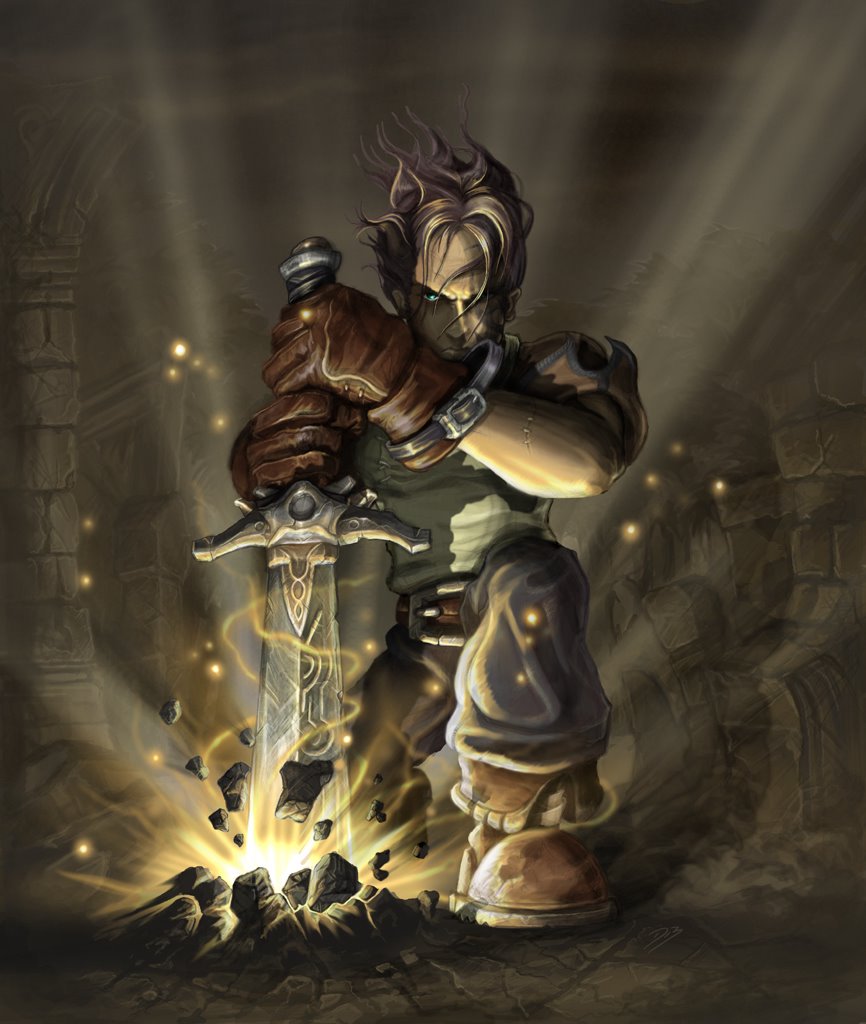
As many of you well know, my blog has been rather sparse as of late. In fact, the crickets have been chirping for well over two weeks by now. The reason for this scarcity is mostly due to the Microsoft game developers for creating one of the most addicting games I have ever played: Fable. So far (according the in-game clock) I have spent over 19 hours the past week or so immersed in a fantasy world.
In Fable you start out as an innocent young boy in a mythical world with magical creatures. As you progress in the game you are forced to make choices that determine whether your character will become good or evil. For example, if you decide to pillage a town and slay its inhabitants, you will obviously earn evil points, and your character will begin to physically express his wicked heart (i.e. you will begin to grow horns out of your head, your eyes will turn red, etc...). But right now my character is aligned to the side of righteousness and I have developed a halo above my head :)

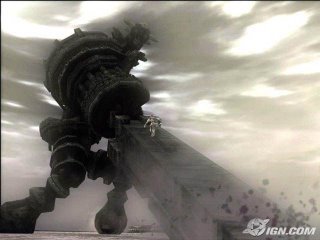
But another game that I got for Christmas has wowed me even more than Fable; Shadow of the Colossus is the most epic and artistic game that I have ever played. It has a very simple setting: the girl that you love has died and so you have traveled to the end of the world to seek out a legendary power rumored to be able to bring the dead back to life. When you arrive you discover a temple filled with 16 statues. The god of the temple informs you that if you wish to bring your love back to life, you must slay the 16 colossi (the incarnations of the statues) that inhabit a desolate, cursed world. Armed with only your sword and bow, you must somehow topple these giants, thousands of times larger than yourself. The game, composed entirely of 16 fights, is strangely captivating, and never gets boring. This is one of those rare games where every moment is great. The first time I fought a colossus my mouth dropped wide open in disbelief. Shadow of the Colossus is easily one of the top five best games ever made.

Ok, well, I'm gonna go slay some giants right now... be back later...

-John

Tuesday, December 13, 2005

Happy Holidays!

Wait! Before you begin to think that I have lost my mind and joined the ranks of our secular, post-modern culture, allow me to explain my title...

With all the recent talk and controversy about whether or not the words "Merry Christmas" should be replaced with the more sociably-acceptable "Happy Holidays," it is doubtless that most Christians (at least the ones who understand the aim of this proposal) have become quite upset at this clear attack against the Christian faith.

However, it is rather ironic that the secularist's very purpose (to rid the public square of anything religious) completely undermines itself in this case. Perhaps if they had paid more attention to what words actually mean, they would presently drop their argument and run away screaming like schoolgirls with their tails between their legs... [sorry, I couldn't resist ; ) ]. But seriously, the word "Holiday" is none other than the contraction of the words "holy" and "day." Betsy Childs, a writer for Ravi Zacharias International Ministries pointed out that, "Although Christmas in the West may have degenerated into a celebration of food, gifts, and time off work, secularists unwittingly keep reminding us that it should, above all, be observed as a holy day!" mmm... The irony is delicious...

Thanks to the secularists, I am reminded that Christmas is very much a "Holy Day." We celebrate the Holy One, appearing in the flesh as the babe in the manger. But we understand that he did not stay in the manger, for it was not his birth, but his death and resurrection that brought salvation to his people. It is Christ's holiness that showed the necessity for God's wrath, wrath that one day he bore so that a people, enslaved to sin and walking in darkness, would be set free and see the brilliance and splendor of His glorious majesty. And that is what we celebrate, a Holy God ransoming and rescuing sinners, to make for Himself a holy people who will all, one day, be gathered around the throne to praise Him for his Holiness.

His holiness gives us our hope, for unless we are clothed in his righteousness, we can not approach the Holy One of Israel. This hope is captured in the words of the beloved Christmas hymn:

O Holy night, the stars are brightly shining;
It is the night of the dear Savior's birth!
Long lay the world in sin and error pining,
Till He appeared and the soul felt His worth.
A thrill of hope, the weary world rejoices,
For yonder breaks a new and glorious morn.
Fall on your knees! Oh, hear the angel voices!
O night divine! O night when Christ was born!
O night divine! O night, O night divine!


Happy Holy Day,

Jonathan

Monday, December 12, 2005

Surprised?


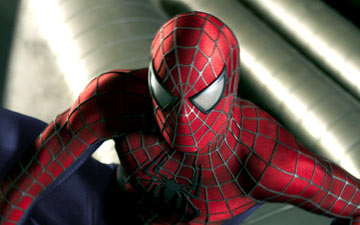
You scored as The Amazing Spider-Man!

After being bitten by a radioactive spider, Peter Parker was transformed from a nerdy high school student into New York's greatest hero. Peter enjoys the thrill of being a super hero, but he struggles with the burdens of leading a double life. He hopes someday to win the heart of his true love Mary Jane, the woman he's loved since before he even liked girls. Right now, he just wants to make it through college and pay his bills.


The Amazing Spider-Man

79%

Neo, the "One"

75%

Maximus

71%

El Zorro

71%

Lara Croft

63%

Batman, the Dark Knight

63%

Indiana Jones

63%

William Wallace

58%

Captain Jack Sparrow

58%

James Bond, Agent 007

54%

The Terminator

50%

Which Action Hero Would You Be? v. 2.0
created with QuizFarm.com

Thanks to JJ for the tip-off to this one.

Monday, December 05, 2005

Aslan, the King of Kings?

In 1950, Clive Staples Lewis introduced the world to one of todays most well-known and beloved fantasy realms, the land of Narnia. The Lion, the Witch, and the Wardrobe (noted as “the LWW” hereafter) was the first of seven Narnia Chronicles to be published and is probably the most celebrated of Lewis’ fictional works. Although from a literary standpoint, the book is thoroughly captivating and considered a masterpiece by most critics, C.S. Lewis managed to create much more than just a great piece of literature. The LWW is richly layered with Christian themes, messages, and parallels that add tremendous depth to an already profound story of courage, hope, and forgiveness. The Chronicles of Narnia: LWW offers the most classic example of a Christian parallel (later to be defined as a Christian supposal) of any fictional book in modern literature. The LWW meets three standards that make it a superb parallel to the Christian faith; it contains a Messiah, or Christ figure, presented as Aslan, the great Lion; it portrays the problem of sin and temptation in the White Witch and Turkish Delight; and it vividly presents the gospel story of forgiveness and redemption through the character of Edmund.


In the land of Narnia, Aslan is the “Son of the Emperor across the Sea,” a great and noble Lion. The very name of Aslan strikes fear in heart of those who delight in evil, yet kindles hope in those who long for his appearing. In order to understand the character of Aslan and his relation to Jesus, one must recognize Lewis’ intention in writing the Narnia Chronicles. Lewis did not set out to create a direct Christian allegory. In fact, Lewis explicitly warns readers against trying to make a one-for-one match between Narnia and the real world. In a May 1954 letter to a fifth grade class in Maryland, he writes, "You are mistaken when you think everything in the books 'represents' something in this world. Things do that in The Pilgrim's Progress but I'm not writing in that way" (Letters to Children). Instead of a straightforward allegory, Narnia is what Lewis called a Christian “supposal.” In a December 1959 letter to a young girl named Sophia Storr, he explains the difference:

I don't say. 'Let us represent Christ as Aslan.' I say, 'Supposing there was a world like Narnia, and supposing, like ours, it needed redemption, let us imagine what sort of Incarnation and Passion and Resurrection Christ would have there.' (Letters to Children)

He elaborates on this point in a December 1958 letter to a lady named Mrs. Hook:

[Aslan] is an invention giving an imaginary answer to the question 'What might Christ become like if there really were a world like Narnia and He chose to be incarnate and die and rise again in that world as He actually has done in ours?' This is not allegory at all. (Letters of C.S. Lewis)

With that being understood, there are some obvious similarities between Aslan and Jesus. The most apparent is the sacrificial death and glorious resurrection that both Jesus and Aslan each undergo. Each lays down his life for another’s, to pay the penalty for a crime that someone else committed so that that person can go free; this theme will be explored further through the character of Edmund. All points considered, Lewis’ depiction of Aslan as the incarnate Messiah of a different world makes the LWW the best example of a Christian supposal in modern literature.


The second Christian theme contained in the LWW is that of sin, evil, and temptation. The White Witch, who claims to be the true Queen of Narnia, is a clear representation of evil and deception. But even more intriguing than the White Witch herself is an enticing concoction that she creates to lure Edmund, one of the four Pevensie children who wanders into Narnia, into her deceptive plan to prevent the prophecy (about her reign coming to an end) of being fulfilled. Turkish Delight is a bewitched candy that the Witch gives to Edmund to put him under her spell and convince him to betray his brother, his sisters, and Aslan. Edmund eventually gives in to his desires. At first, it’s just for the Turkish Delight, but soon afterwards for the Witch’s feigned promises of power and prestige. The story of Edmund’s temptation alludes to Jesus’ teaching in Matthew chapter eight, where He explains that “everyone who commits sin is the slave of sin.” The New Testament writer James also expands on this theme, “…each one is tempted when he is carried away and enticed by his own lust. Then when lust has conceived, it gives birth to sin; and when sin is accomplished, it brings forth death” (James 1:14-15 NASB). In fact, the sentence that Edmund receives for his treachery is certain death from the White Witch; she refers to the “deep magic” written on the Stone Table that states if anyone becomes a traitor, then they rightfully belong to the White Witch. The deep magic written on the Stone Table is much akin to the Law that only brings sin and death, which the New Testament writers explain in their gospels and epistles. The apostle Paul declares that “all have sinned and fallen short of the glory of God,” and that the “wages of sin is death…” (Romans 3:23 and 6:23 NASB). Finally, Edmund realizes his mistakes and deeply wishes that he could take them back. But first, the “deep magic” must be dealt with or Edmund will receive certain death. This powerful Christian imagery demonstrates Lewis’ literary genius and helps to create the LWW as a classic example of a fictional Christian supposal.


Finally, the most important theme that the LWW contains is the gospel message of forgiveness and redemption. Since Edmund is guilty of betraying his friends and cannot save himself from his deserved punishment, he needs someone to intervene, to take his place. Aslan does just that; in what seems like foolishness, Aslan sacrifices himself on Edmund’s behalf while patiently enduring brutal torture until he is eventually murdered by the White Witch and her minions. This is a direct parallel of Jesus’ death and crucifixion. The Old Testament prophet, speaking of the Messiah, wrote these words,

He was pierced through for our transgressions; He was crushed for our iniquities… He was oppressed and He was afflicted, yet He did not open His mouth; like a lamb that is led to slaughter, and like a sheep that is silent before its shearers, so He did not open His mouth. (Isaiah 53:5,7 NASB)

If the story ended there, all would be lost; the White Witch would rule Narnia and Edmund’s life would be forfeit. But death was not victorious. With a great cracking and deafening noise the stone table was split in two and Aslan rose. Confused, the two Pevensie girls asked Aslan what had happened. Aslan explains that,

…though the Witch knew the Deep Magic, there is a magic deeper still which she did not know. Her knowledge goes back only to the dawn of time. But if she could have looked a little further back, into the stillness and the darkness before time dawned, she would have read there a different incantation. She would have known that when a willing victim who had committed no treachery was killed in a traitor’s stead, the Table would crack and Death itself would start working backwards. (75)

Very similarly, when Jesus died, the curtain of the temple was torn from top to bottom and when he rose from the dead he appeared to his disciples. Just as Aslan took the place of Edmund, Jesus took the place of sinners who were bound by the Law to sin and death. The “deeper magic from before the dawn of time” is parallel to God’s plan for salvation for all those who would ever believe in Him. Speaking of the resurrection of Christ, the apostle Paul writes,

‘O Death, where is your victory? O death, where is your sting?’ The sting of death is sin, and the power of sin is the law; but thanks be to God, who gives us the victory through our Lord Jesus Christ. (1 Corinthians 15:55-56 NASB)

The gospel story in the LWW is a vivid representation of forgiveness and redemption found in Jesus, which makes Lewis’ story a classic Christian supposal.


Even with all of its heavy Christian imagery, one may still argue that the LWW is only a fantasy story that happens to have “spiritual” themes. This is derived from the fact that so many people will read the Narnia Chronicles without ever noticing the Biblical parallels. Although this may be true, one must remember that C.S. Lewis very clearly explained that the Narnia was a Christian supposal, and though the LWW does have “spiritual” themes, they are undeniably Biblical. In fact, at the end of The Voyage of the Dawn Treader, Aslan explains that He lives in the real world as well as in Narnia,

…but there I have another name. You must learn to now me by that name. This was the very reason why you were brought to Narnia, that by knowing me here for a little, you may know me better there. (123)

In June 1953, an eleven-year-old girl named Hila wrote to Lewis, asking what the other name that Aslan went by in our world was. Lewis replied,

As to Aslan's other name, well I want you to guess. Has there never been anyone in this world who (1) Arrived at the same time as Father Christmas. (2) Said he was the son of the Great Emperor. (3) Gave himself up for someone else's fault to be jeered at and killed by wicked people. (4) Came to life again....Don't you really know His name in this world. (Letters to Children, 1996)

The Chronicles of Narnia convey undeniably Biblical references and parallels which help to make it a spectacular example of a Christian supposal.


In summary, The Chronicles of Narnia: the Lion, the Witch, and the Wardrobe, contains the most important tenets of the Christian faith which makes it an ideal parallel in the world of fantasy literature. By supposing Christ in the character of Aslan, demonstrating the fatal problem of sin and temptation, and retelling the gospel story through the character of Edmund, the LWW becomes the most classic example of a Christian supposal in fictional literature. When all has been heard, readers and fans of C.S. Lewis and his Narnia Chronicles can appreciate all-the-more his keen ability to masterfully intertwine such beautiful stories with rich Christian imagery into an unforgettable masterpiece that continues to stand the test of time.

A true Narnian,

Jonathan